|
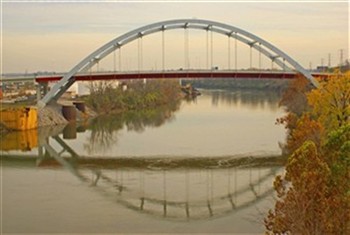
How we go about Building Bridges
|
 |
In the 21st century, more and more people are becoming interested in building bridges to bring peoples together, for example, during an interview with Afrik.com in 2004, Al Walser, Franco's grandson, (half Swiss, half Congolese), expressed his desire to build a bridge, musically-speaking, between Africa and the rest of the world.
I particularly warmed to the vision of "Bridge Builders of Anchorage" http://www.bridgebuildersak.org/CommunityofFriends.html which is to build a community of friends in their town by organising gatherings of people with different cultural backgrounds. People are paired together and invite one-another to dinner. Friendships are built that give a deeper sense of community life, improve mutual understanding and enable people to help one-another in practical ways.
I am no expert in bridge construction but I imagine that before building a bridge, certain aspects such as what type of ground we will be building upon; mud, sand, clay, bedrock and the length of the crossing must all be taken into account. Bridges can be built using different materials (subject to availability), and in many forms. Safety features can be added if the region is susceptible to earthquakes.
Of course, the Samuel Network is not a construction company; we are seeking to build links both sides of the Mediterranean between peoples and organisations via exchanges, joint projects and mutual adoption. There are only 13 km (8 miles) separating Spain from Morocco at the narrowest point of the Straits of Gibraltar. However, the cultural distance between Europe and North Africa is far more significant. Language and economic differences intensify this feeling of distance and present real barriers.
There is only one way to overcome these challenges : CONTACT. Some have expressed concern regarding how we will communicate with one another. Perhaps I am an idealist, but the time I spent with Brazilian, Romanian and Kabylie women in their own homes was enriching and worthwhile despite the frustations of not being able to communicate with oneother as we would have liked. Besides, translators are nearly always at hand and languages can be learnt! It would be sad if such understandable fears meant we never moved out of our own comfort zone towards others... |
|
Raficka YASSUR, 24/01/2008
|
|
|
|
